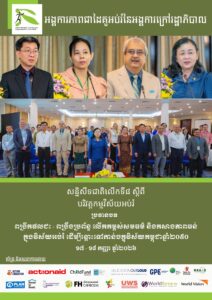
NGO Education Partnership (NEP) organized the 8th National Conference (NC) on Transforming Education on 17–18 September 2026 at Hotel Cambodiana, Phnom Penh. The Conference brought together 277 participants, including 117 women, from 166 organisations/Institutions, representing government institutions, the National Assembly, civil society organizations, development partners, United Nations agencies, education authorities, teachers, school leaders, researchers, youth, and representatives of marginalized and underserved communities. Building on the 7th NC in 2025, the 8th NC focused on a central challenge facing education reform: how to translate established policies, strategies, and commitments into effective implementation and measurable improvements for learners, teachers, schools and communities.
Cambodia has made significant progress in expanding access to education and strengthening its education system. The Education Strategic Plan (ESP) 2024–2028 and other national reforms provide an important foundation for continued transformation. The Conference recognized that the next phase requires stronger implementation, accountability, evidence-based decision-making, adequate and equitable financing, and improved use of data to monitor results.
The Conference focused on six interconnected priority areas:
– Fair and Sustainable School Financing
– Every Child Can Learn
– Technology in Education – Conditions for Impact and Safety
– Climate-Resilient Schools
– Second Chances and Flexible Learning Pathways
– A Qualified, Supported and Fairly Paid Teaching Profession
Through thematic workshops, participants reviewed and refined proposed advocacy priorities against criteria including relevance, feasibility, specificity, measurable results, financing, equity, and institutional responsibility. The process moved the discussion beyond broad policy statements towards concrete advocacy asks. Among the key proposals were a Cambodia-specific education financing roadmap towards 2.5% of GDP by 2028; progressively stronger needs-based school financing; improved transparency and timeliness of school fund disbursement; strengthened disability identification and referral systems; expanded multilingual and early childhood education; stronger early warning and dropout prevention mechanisms; evidence-based and safe use of digital technology and AI; climate-resilient school infrastructure and financing; financed re-entry and equivalency pathways for out-of-school adolescents; stronger links between general education, non-formal education and TVET; improved teacher remuneration and rural deployment; stronger teacher professional development; and integrated education workforce and school data systems.
A central contribution of the Conference was the development of inputs for the National Education Advocacy Agenda 2026–2028. The agreed advocacy asks are intended to be linked to targets, responsible institutions, indicators, financing considerations and timelines. The Conference also reinforced the importance of measuring progress not only by whether policies are adopted, but by whether they are implemented and whether implementation produces tangible improvements for learners, teachers and schools.
The Conference Statement is expected to be finalized and publicly released in October 2026. The next phase will focus on finalizing the National Education Advocacy Agenda, engaging responsible institutions, supporting policy and budget processes, monitoring implementation, and reviewing progress through evidence.