The Quality of Lifelong Learning
The quality of lifelong learning requires learners to be able to learn independently by using various means at any time and in any place. This enables people to develop the capacity to perform their work effectively in the digital age. The development of libraries is also an important goal that contributes to the development of 21st-century human capital. It aims to strengthen people’s qualifications and enable them to become fully capable human resources who can contribute to reforms and respond effectively to changing needs.
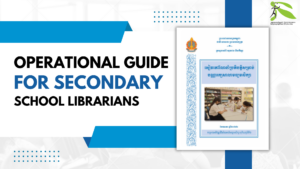
This Operational Guide for Secondary School Librarians has been developed to respond to the development of school libraries in Cambodia, which are still at an early stage compared with modern libraries in developed countries. Librarians, who are often teachers responsible for managing libraries in rural areas, have not yet received professional training in library science. Some of them have also had limited opportunities to participate in school library activities.
A school library is a room or building where books, information materials, magazines, newspapers, audio recordings, and videos are kept together. These materials are referred to as the library collection. All kinds of information can be found within this collection. A library can be large or small. Some people think that a library must be large in order to operate effectively, but this is not necessarily true.
Many secondary schools have fewer than 200 books, while most primary schools have even fewer books. In order to make the best use of school books, it is necessary to organize them carefully. The best way to do this is to establish a school library.
Why Does a School Need a Library?
A school needs a library because a library supports the school’s literacy and educational activities. School libraries are useful in supporting literacy from the earliest stages of children’s development because they help encourage and develop good reading habits among children from a young age.
All teachers should focus on encouraging children to become curious about books and motivating students to develop a love for the written word. One of the best ways to achieve this is to establish a school library with a wide variety of information materials and a broad range of fiction books.
The vocabulary level of these books should be appropriate for all levels so that even students who do not enjoy reading can find something they want to read. Students should be able to choose what they want to read, when they want to read it, and use the library to support their learning.